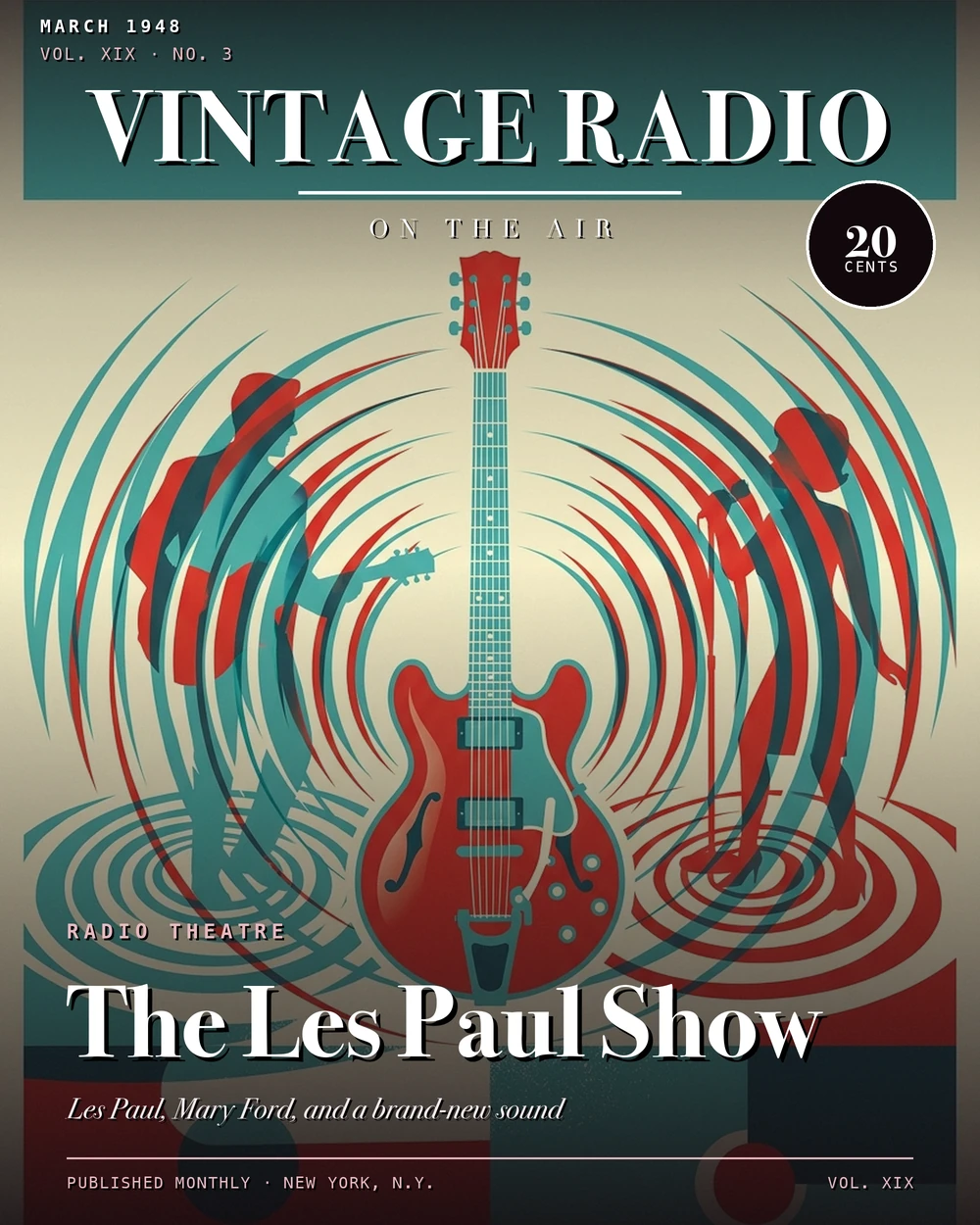
The Les Paul Show
A Guitar Inventor Takes Over the Airwaves
The Les Paul Show was a 15-minute NBC radio program that ran from March 30 to November 16, 1950 — roughly 23 weeks in all. It was built around one of the more unusual figures to ever get his own radio slot: Les Paul, born Lester William Polsfuss on June 9, 1915, simultaneously one of the most gifted guitarists of his era and one of its most restless recording engineers. By the time the show premiered, Paul had already released "Lover (When You're Near Me)" on Capitol Records in 1948 — a single on which he played eight separate guitar parts layered together, the first commercial release to use multitracking. That combination of performance and invention defined everything about the show.
The program was small in scale but unusual in concept. The cast was three people: Paul on guitar, his wife and vocalist Mary Ford (born Colleen Summers), and rhythm player Eddie Stapleton. Paul and Ford had married on December 29, 1949, just three months before the premiere. The show's warmth came partly from that newness — the easy back-and-forth between two people who had just started a life together and were now broadcasting it, in a relaxed way, into American living rooms.
How It Sounded
Each episode presented re-interpretations of jazz and pop standards. The episode titles in the catalog give a good sense of the repertoire: "In the Mood," "Little Rock Getaway," "Sweet Georgia Brown," "Sweet Sue," "Brazil," "Tiger Rag," "Guitar Boogie," "Dark Eyes," "Nola," and "Hip Billy Boogie." These weren't reverent readings of the originals. Paul treated familiar material as a starting point, layering his guitar parts and using sound effects to create something denser and more textured than anything a trio of live musicians could produce in a single take.
The show blended pop, jazz, and more experimental impulses — and it did so in 15 minutes per episode, which required economy. The music was the engine. Between songs, Paul and Ford provided gentle humor, the kind of easy domestic banter that suited the format and helped listeners understand what they were hearing. Paul was already working with techniques — overdubbing, tape delay, phasing — that most radio audiences had no framework for, and the conversational segments helped bridge that gap without turning the program into a lecture.
One recurring element made that explanation more fun: Paul introduced the fictional "Les Paulverizer," a made-up device he described as the source of his layered guitar sounds. It was comedic shorthand for explaining multitracking to listeners who had no idea how he was doing what he was doing. The Paulverizer became a signature running joke of the program, a way to acknowledge the strangeness of the music without demystifying it entirely.
The Man Running the Board
What made the show genuinely unusual for its time was the degree of control Paul exercised over every aspect of it. As he described it to Sound on Sound: "I produced, I directed, I wrote the script, I acted and I played." For a network radio program in 1950, that level of individual control was rare. Most programs of that scale had producers, directors, and writers as separate roles. Paul collapsed all of it into himself.
The recording setup made that possible. Because Paul had switched to magnetic tape, the show didn't need a studio or a fixed broadcast location. Episodes were recorded at Paul and Ford's home — at the time, Paul was based in California, working from a garage studio setup — and he could also record episodes in hotel rooms while on tour. That portability was genuinely unusual for a network program in this era. The show sounded like a home production because it largely was one, and that informality was part of its texture.
Paul's earlier NBC experience meant he understood the network's rhythms. From 1937, he had worked with Fred Waring and the Pennsylvanians on NBC radio, and his Les Paul Trio had also been hired by the network. The 1950 show wasn't his introduction to the medium — it was closer to a culmination of what he'd been building toward technically and musically.
It's also worth noting where Paul sat in the larger story of multitrack recording. He was among the first to attract widespread attention for these techniques, but not the first to use them. His specific contributions — sound-on-sound tape recording, and later commissioning the first 8-track recorder — pushed the technology in directions that shaped popular music for decades. The radio show was, in a sense, the public face of that ongoing experiment.
What It Left Behind
The Les Paul Show ran fewer than six months before ending in November 1950. Whether it was canceled or simply concluded isn't clear from the record. What followed, though, suggests the format had staying power. Two years later, Paul and Ford adapted the same basic concept for television: "Les Paul & Mary Ford at Home" was a five-minute, Listerine-sponsored NBC TV program recorded at their home in Mahwah, New Jersey. It ran for 170 episodes between 1952 and 1955 and continued in syndication until 1960. The radio show was, in retrospect, the proof of concept.
Paul was inducted into the Rock and Roll Hall of Fame in 1988, received the Technical Grammy Award in 2001, and entered the National Inventors Hall of Fame in 2005. In 1991, Capitol Records released a compilation called The Legend and the Legacy that included full episodes of the radio show — treating the broadcasts themselves as part of his artistic record, not just as promotional material. Paul died on August 12, 2009.
The catalog holds 18 surviving episodes, including an "Audition Show" that captures the program at its starting point, before the format settled into its weekly rhythm. Eighteen episodes out of 23 weeks is a high survival rate for a short-run program from this period, and the range of titles suggests the catalog catches most of what the show had to offer: the jazz standards, the novelty instrumentals, the pop treatments, and the low-key humor that ran between them.